

- Services
- All Services
- All Locations
- Surveying
- Drone Infrastructure Services
- Drone Services for Agriculture
- Drone Inspection for Cell Towers
- Drone Media Services
- Drone Mapping Services
- Drone Mining Inspection
- Drone for Surveillance And Security
- Industrial Robotics and Unmanned Systems
- Semiconductor Design and Innovation Services
- Factory Automation Solutions
- Portfolio
- Unmanned Products
- Drone Training
- Blog
- Brochure
- Contact us
- Services
- All Services
- All Locations
- Surveying
- Drone Infrastructure Services
- Drone Services for Agriculture
- Drone Inspection for Cell Towers
- Drone Media Services
- Drone Mapping Services
- Drone Mining Inspection
- Drone for Surveillance And Security
- Industrial Robotics and Unmanned Systems
- Semiconductor Design and Innovation Services
- Factory Automation Solutions
- Portfolio
- Unmanned Products
- Drone Training
- Blog
- Brochure
- Contact us
Swarm Drone Technology for Large-Scale Inspections Is Redefining Industrial Monitoring
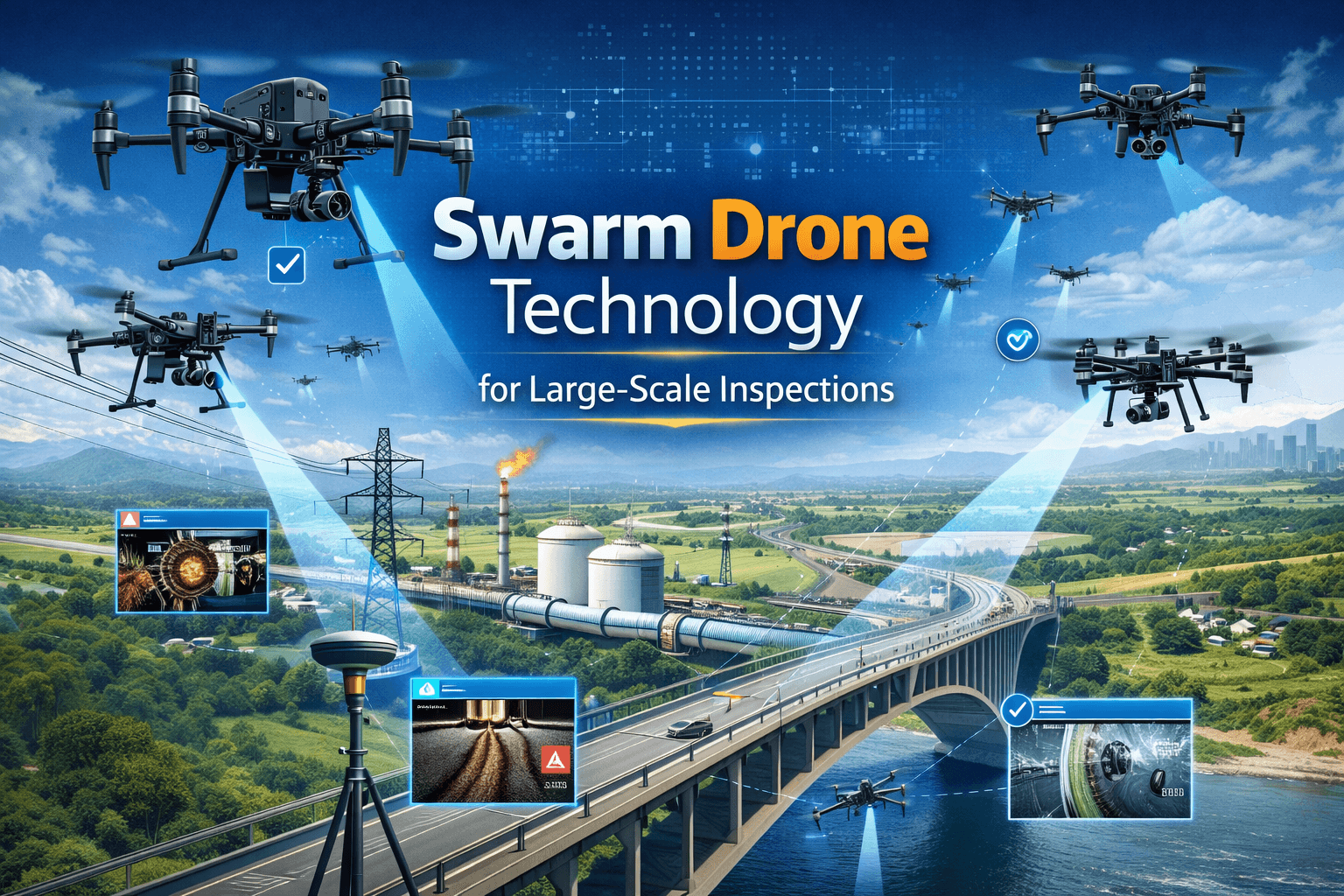
Swarm drone technology for large-scale inspections is emerging as one of the most transformative innovations in the drone services industry. Instead of relying on a single UAV to cover extensive infrastructure, multiple drones now operate together in a coordinated system—sharing data, dividing tasks, and completing inspections faster than ever before.
As industries expand and infrastructure networks become more complex, traditional inspection methods often struggle to keep up. Swarm technology introduces automation, scalability, and intelligence that significantly improve efficiency in large-scale operations.
What Is Swarm Drone Technology?
Swarm drone systems consist of multiple UAVs programmed to work collaboratively under centralized or distributed control. Inspired by natural swarm behavior seen in birds and insects, this technology enables drones to communicate, coordinate movements, and execute tasks simultaneously.
In swarm drone technology for large-scale inspections, each drone is assigned a specific section of an asset—such as pipelines, power lines, bridges, or solar farms. Together, they create a synchronized inspection network that maximizes coverage while minimizing redundancy.
Why Large-Scale Inspections Need Swarm Technology
Industries like oil & gas, utilities, renewable energy, railways, and smart cities often manage vast infrastructure networks. Inspecting these assets manually or with a single drone can be time-consuming and costly.
Swarm drone technology for large-scale inspections addresses these challenges by:
- Reducing inspection time significantly
- Covering larger geographic areas simultaneously
- Minimizing downtime for critical infrastructure
- Enhancing safety by reducing human exposure
- Increasing operational scalability
For example, inspecting hundreds of kilometers of pipeline or transmission lines can now be completed in a fraction of the time compared to conventional methods.
Key Benefits of Swarm Drone Technology for Large-Scale Inspections
1. Faster Data Collection
Multiple drones operating simultaneously drastically shorten inspection cycles. This makes swarm drone technology for large-scale inspections ideal for time-sensitive projects.
2. Enhanced Data Accuracy
With synchronized flight paths and advanced GPS correction systems, swarm drones maintain consistent coverage and reduce data gaps.
3. Increased Safety
Inspecting hazardous sites such as high-voltage power lines or offshore platforms becomes safer when multiple drones operate autonomously.
4. Real-Time Data Sharing
Swarm systems use cloud integration and AI-driven analytics to process inspection data instantly.
5. Cost Efficiency
Although deploying multiple drones may seem expensive initially, reduced operational time and improved productivity deliver strong long-term ROI.
Industries Benefiting from Swarm Drone Inspections
The adoption of swarm drone technology is growing rapidly across sectors:
Energy & Utilities
Simultaneous inspection of power grids, substations, and solar farms.
Oil & Gas
Pipeline corridor monitoring and refinery inspections.
Railways & Transport
Track inspections and large bridge assessments.
Infrastructure & Construction
Monitoring mega projects and smart city developments.
Renewable Energy
Wind turbine and solar panel farm inspections at scale.
These applications demonstrate how swarm systems improve efficiency in large infrastructure environments.
AI and Automation in Swarm Drone Systems
Artificial Intelligence plays a crucial role in swarm drone technology for large-scale inspections. AI algorithms manage collision avoidance, route optimization, and task allocation among drones. Additionally, real-time analytics detect structural defects, corrosion, thermal anomalies, or vegetation encroachment during flight.
Advanced swarm systems can also adapt dynamically—redistributing drones if one unit experiences technical issues.
Challenges to Consider
While swarm drone technology for large-scale inspections offers numerous advantages, companies must address certain challenges:
- Airspace regulations and compliance
- Reliable communication networks
- Data security and encryption
- Advanced pilot training and system management
- Integration with existing asset management systems
Overcoming these barriers requires experienced drone service providers and robust operational planning.
The Future of Swarm Drone Inspections
The future of swarm drone technology for large-scale inspections looks promising. Emerging innovations include:
- Fully autonomous swarm fleets
- Drone docking and automated charging stations
- 5G-enabled ultra-fast communication
- AI-powered predictive maintenance systems
- Integration with digital twin platforms
As industries increasingly adopt automation, swarm drone systems will become a standard solution for large infrastructure monitoring.
Conclusion
Large-scale inspections demand speed, precision, and reliability. Swarm drone technology provides a powerful solution that combines automation, scalability, and real-time intelligence.
By enabling multiple drones to operate collaboratively, businesses can reduce inspection time, improve data quality, enhance safety, and optimize operational costs. As technology continues to evolve, swarm drone systems will play a vital role in shaping the future of industrial inspections and infrastructure monitoring.