

- Services
- All Services
- All Locations
- Surveying
- Drone Infrastructure Services
- Drone Services for Agriculture
- Drone Inspection for Cell Towers
- Drone Media Services
- Drone Mapping Services
- Drone Mining Inspection
- Drone for Surveillance And Security
- Industrial Robotics and Unmanned Systems
- Semiconductor Design and Innovation Services
- Factory Automation Solutions
- Portfolio
- Unmanned Products
- Drone Training
- Blog
- Brochure
- Contact us
- Services
- All Services
- All Locations
- Surveying
- Drone Infrastructure Services
- Drone Services for Agriculture
- Drone Inspection for Cell Towers
- Drone Media Services
- Drone Mapping Services
- Drone Mining Inspection
- Drone for Surveillance And Security
- Industrial Robotics and Unmanned Systems
- Semiconductor Design and Innovation Services
- Factory Automation Solutions
- Portfolio
- Unmanned Products
- Drone Training
- Blog
- Brochure
- Contact us
Drone Monitoring for Gas Distribution Networks Is Transforming Urban Infrastructure Safety
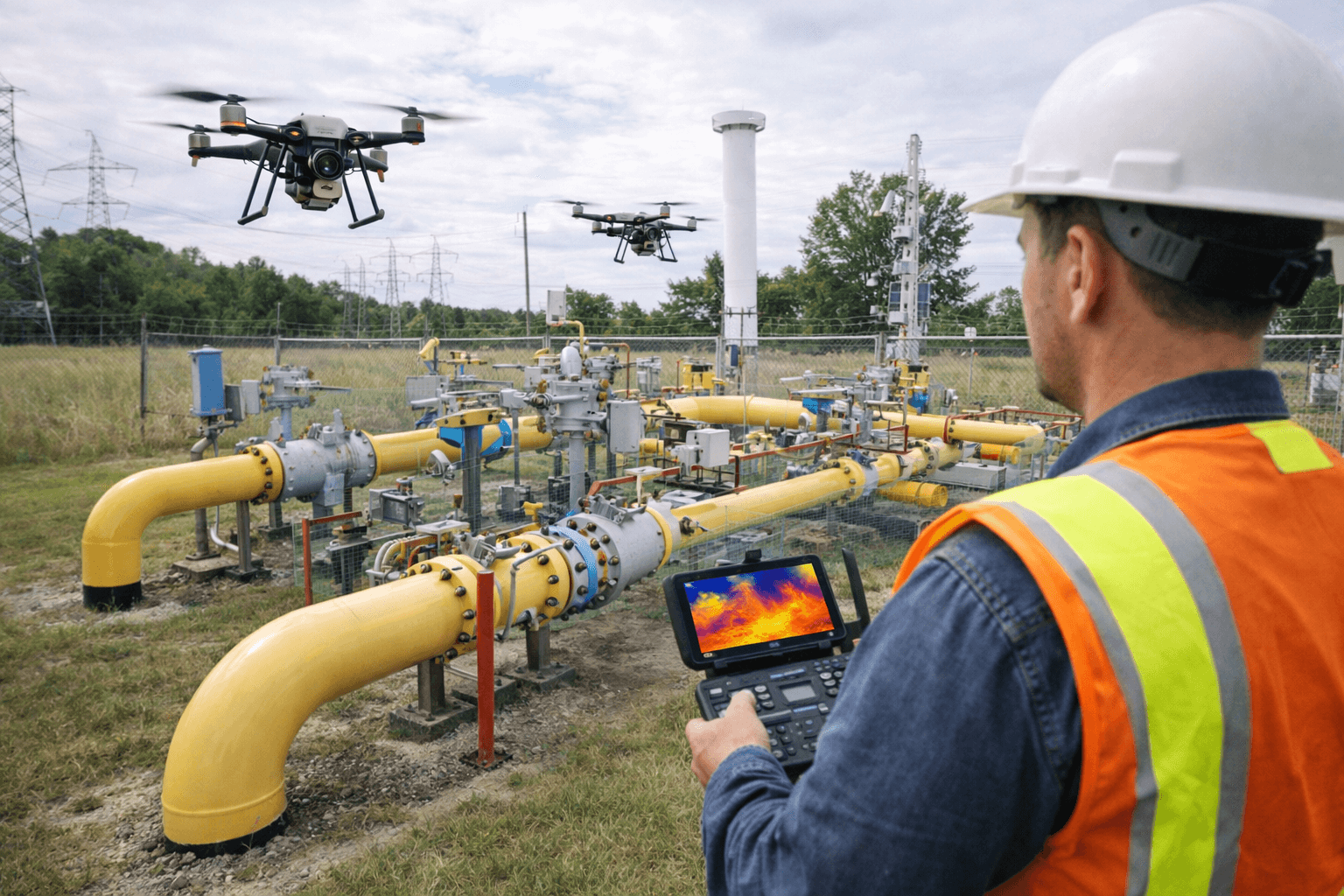
Drone monitoring for gas distribution networks is rapidly becoming an essential solution for ensuring safety, efficiency, and reliability in densely populated urban areas. As cities expand and underground and overhead gas pipelines grow more complex, traditional inspection methods often struggle to keep pace. Drones equipped with advanced sensors and real-time analytics now provide a safer, faster, and more accurate way to monitor gas infrastructure.
Urban gas distribution systems require constant oversight to prevent leaks, structural damage, or unauthorized interference. Modern drone technology offers a proactive approach that significantly enhances monitoring capabilities.
The Challenges of Urban Gas Distribution Monitoring
Gas distribution networks in cities run through residential neighborhoods, commercial districts, industrial zones, and public infrastructure corridors. Monitoring these networks presents several challenges:
- Limited physical access to underground pipelines
- Traffic congestion affecting inspection teams
- High population density increasing safety risks
- Aging infrastructure requiring frequent checks
- Strict regulatory compliance requirements
This is where drone monitoring for gas distribution networks provides a strategic advantage. By deploying aerial systems, utility providers can conduct inspections without disrupting urban life.
How Drone Monitoring Works in Urban Areas
Modern drones used for drone monitoring for gas distribution network are equipped with:
- Thermal imaging cameras
- Methane detection sensors
- High-resolution optical cameras
- LiDAR systems for terrain mapping
- Real-time GPS tracking
These technologies allow drones to detect gas leaks, corrosion, structural weaknesses, and unauthorized excavation activities. Data is transmitted to cloud-based platforms for instant analysis and reporting.
With autonomous flight planning, drones can follow pre-programmed routes along pipeline corridors, ensuring consistent coverage across the network.
Key Benefits of Drone Monitoring for Gas Distribution Networks
1. Enhanced Public Safety
Urban gas leaks can lead to severe accidents. Drone monitoring for gas distribution networks enables early detection of leaks, minimizing risks to residents and businesses.
2. Faster Leak Detection
Methane sensors mounted on drones can identify even minor leaks quickly, allowing maintenance teams to act before issues escalate.
3. Reduced Operational Costs
Compared to manual inspections, drone-based monitoring requires fewer personnel and less equipment, reducing overall operational expenses.
4. Minimal Disruption
Drones operate without blocking roads or interrupting public services, making them ideal for crowded city environments.
5. Improved Data Accuracy
With AI-powered analytics and GPS precision, drone monitoring for gas distribution networks provides consistent and reliable inspection data.
Real-Time Analytics and Cloud Integration
One of the most significant advantages of drone monitoring for gas distribution networks is real-time data processing. As drones capture inspection data, it is uploaded to secure cloud platforms where AI algorithms analyze:
- Temperature anomalies
- Gas concentration levels
- Structural irregularities
- Encroachment risks
Utility companies can access dashboards remotely, enabling quick decision-making and coordinated response efforts.
Regulatory Compliance and Reporting
Urban gas utilities must comply with strict safety and environmental regulations. Drone monitoring for gas distribution networks supports compliance by generating:
- Time-stamped inspection reports
- Geo-tagged imagery
- Automated maintenance logs
- Digital documentation for audits
This streamlined documentation process simplifies regulatory reporting and enhances transparency.
Future of Drone Monitoring in Urban Gas Networks
As cities adopt smart infrastructure systems, drone monitoring for gas distribution networks will become even more advanced. Future developments may include:
- Autonomous drone docking stations for scheduled inspections
- AI-driven predictive maintenance models
- Integration with smart city control centers
- 5G-enabled live streaming of inspection data
With increasing urbanization and infrastructure complexity, drone-based monitoring solutions will play a critical role in maintaining safe and efficient gas distribution systems.
Conclusion
Urban gas distribution networks are vital to modern city life, but they require constant and precise monitoring to ensure safety. Drone monitoring for gas distribution network offers a reliable, cost-effective, and technologically advanced solution for infrastructure oversight.
By combining advanced sensors, real-time analytics, and cloud-based reporting, drone technology empowers utility providers to enhance safety, improve efficiency, and protect communities. As urban environments continue to grow, adopting drone monitoring solutions will be essential for building resilient and secure gas infrastructure systems.